Adding Digital Reverb Unit To My Octal Fatness Tube Amp
By Paul Marossy
Last updated 8/7/10
I really hate a dry amp with no reverb at all. But I love the sound of my Octal Fatness which had no reverb. I didn't a reverb pedal on my pedal board, I wanted it in the amp itself. Having been very satisfied with the results of adding digital reverb to my Gregory Mark X tube amp, which has been working problem free for the last year, I have been comtemplating doing the same thing with my Octal Fatness. The main thing that put me off was actually how to do it. So I decided to just order another digital reverb kit and figure out how to put it in the amp. Below are some details of how I did it.
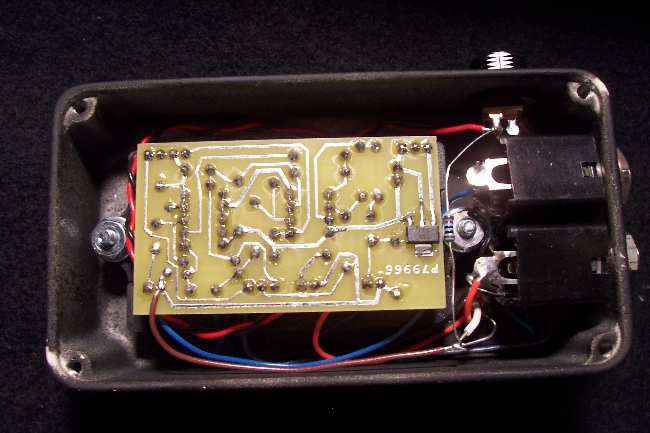 |
The biggest obstacle was getting all this stuff into a Hammond 1590B enclosure. I thought long and hard about the best way to do it. I used it mainly because it was a leftover needing to be used for something. It was originally an almond color. I spray painted it flat black. The reverb circuit is the good sounding GGG Digital Reverb Kit that uses a Belton "reverb brick". | 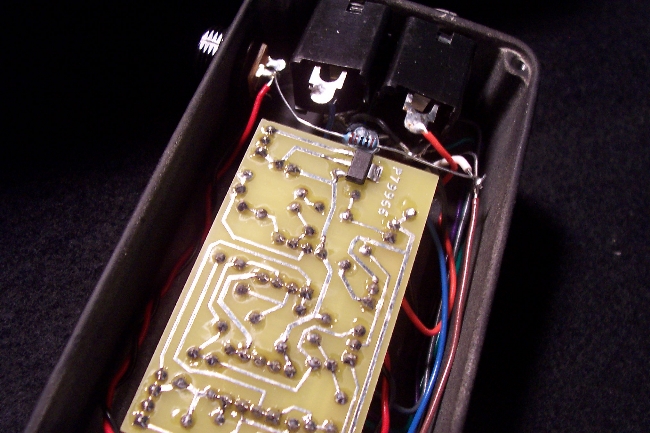 |
The area where the jacks, pot and DC jack is was particularly challenging. It's a tight fit, but I got it all in there. I had to grind the edge of the bottom plate down so it would fit on over the input/output jacks. |
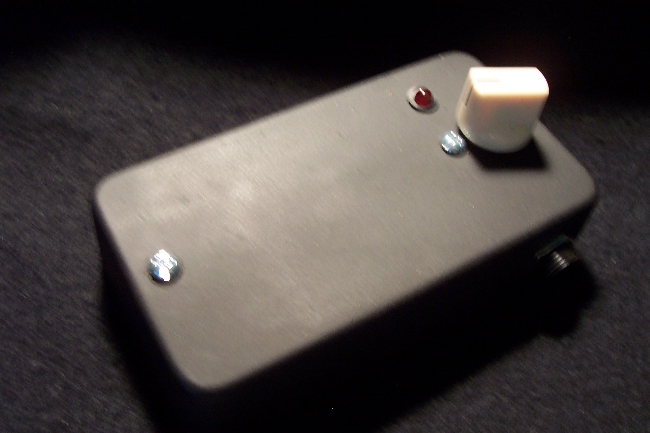 |
Here is what it looks like from the outside. The LED is just there for verifying that the unit is getting power. I didn't put a bypass switch on this one because in my experience, one hasn't been necessary. The unit in my other amp has not failed and I always have the reverb on. |
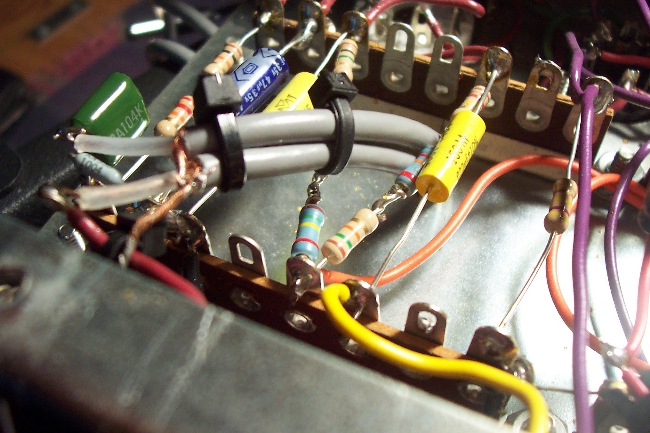 |
Like I did with my Gregory Mark X project, I simply inserted the reverb circuit between the input jack and the input to the preamp section of the amp. There was already a little slotted hole for the shielded cables to pass through, so I just used it. |
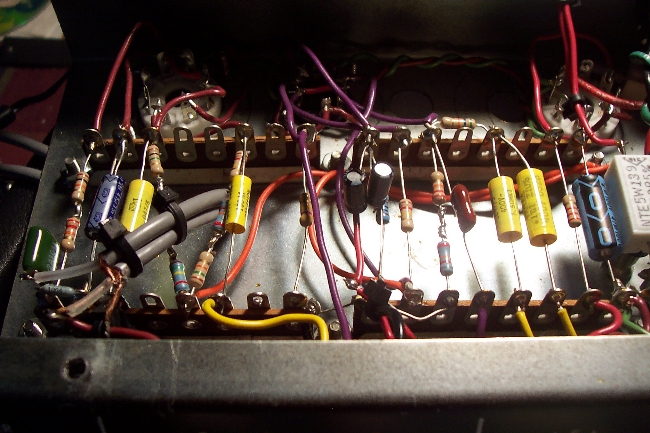 |
Where those wires come up through the chassis was a good location in an already cramped chassis. |
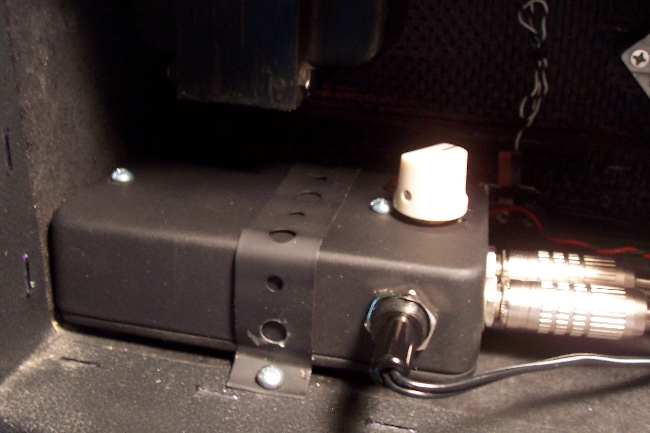 |
Here is the unit installed in the enclosure. I used a pipe strap to hold it down, also painted flat black. On this one, I just used regular 1/4" jacks for making the connections to the unit. The DC power jack is also conveniently located. |
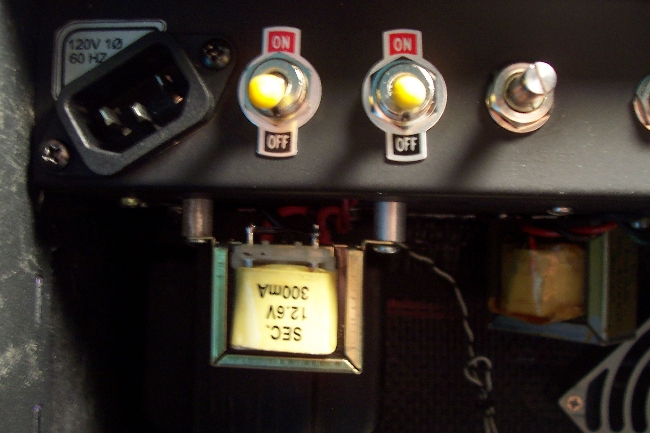 |
The other challenging thing was how to power the reverb circuit. On this build, I didn't have a second power transformer already available, so I had to add one. I used a 12.6 VAC RadioShack transformer because I had it lying around not being used, and it supplies an adequate voltage. Fortunately, I was able to place it in a good location. The 120V primary side was shrink tubed and is on the other side where it's basically untouchable. |
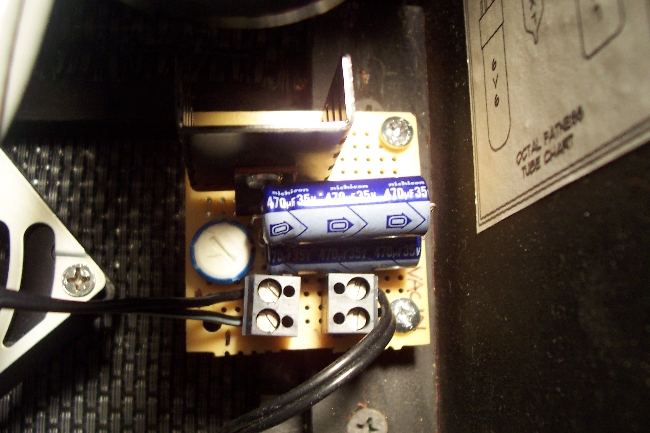 |
This little circuitboard rectifies the 12.6 VAC and has an LM350 adjustable voltage regulator which is set to 9.5 VDC, which is what the average 9V alkaline battery measures when new. The mini screw clamped terminals make removal of the assembly very easy. I have a pretty large heatsink on the LM350, only because it was also something I had lying around not being used. | 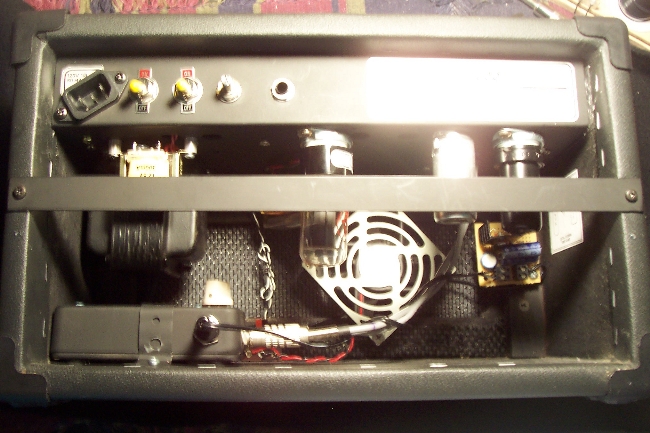 |
This is what it looks like when installed in the amp. The nice thing about all of this is that it is very easily completely reversible if I ever decide to take the reverb unit out of the amp for whatever reason. |